If the Mind-Eternal is to be Devoured, it must first be Deflowered …
Writing & Illustrating by Edmund Dalpe, MFA., BA.; Editing by Lori D. Dalrymple-Dalpe, M.Ed.; Copyright, 4th of July ’26, All Rights Reserved. TheLionsgait.com
“From Plato’s initial assault on Art to academia’s linguistic larceny, that husbanding process required more than two millenniums of regimenting the social mind; i.e., the Mind-Eternal’s transfiguration from the archetypal language of Art to a symbolic mind-system.
What is also apparent is the transformation of that mind-system from human to machine is that construct’s logical conclusion, which is troubling; that academia had no qualms about the transfiguration of the most amazing mind that nature has ever entertained into a Tuffy Tool™, and now dreams of interfacing it with an appliance.
Moreover, when we consider the vast sums of money being spent annually on propaganda and the digital AI control grid, the question of what the enframing nature of AI on the Mind-Eternal will be begins to clarify.”
Edmund Dalpe, MFA. July 4th 2026.
- The Preliminaries:
- A Dubious Narrative:
- A Legion of One:
- Anachronistic Chronicling:
- Human Husbandry:
- Out of the Frying-Pan, and into the Fire:
- High Maintenance:
- Root Access is Denied:
- Reawakening, or Clean-Break:
The Preliminaries:
Ordinarily, I do not informally introduce myself when writing. However, considering the virtual venue in which we socialize, and the subject of this treatise, I believe it will be reassuring for the reader to know they are not browsing a discombobulated facsimile of human thoughts manufactured by an AI appliance.
Ergo, my name is Edmund Dalpe. I am a human being, not a machine, and AI was not used in any fashion in the writing or illustrating of this treatise —done!
… All right, for those skeptics opining that I could be an appliance prone to misleading statements, I will say that introductory protocol is sufficient. Because, if AI is found to be deliberately duplicitous, it is finished, as credibility is its only stock in trade.
In the future we can expedite the protocol, in the same way we use non-GMO and organically grown labels to identify foods we prefer for healthy minds and bodies. However, I think the positive, not the negative label approach would serve Art, not academia.
For example, MIND (Mentally Inspired Non-Cartesian Discourse), instead of using the non-AI label, because I prefer not to have the AI acronym on my creative works, as it creates an unwanted distraction, and an unwarranted association. Nevertheless, on the issue of not being an appliance, I will expound a bit to set your mind at ease:
I am a conceptual artist, which means I give precedence to ideas, not technique, as I find slick presentations a dishonest distraction to conceal a lack of original thinking. In my practice I have found writing is often a progressive venue from which I speak from a liminal mindset; a bridge if you will, as a line of communication between divergent mentalities, like academia and the arts, which grants me a modicum of insight about an interface between a machine and the natural cognitive processes of the creative human mind.
If I was being too subtle, the offense to academia was intentional, and there is more rebuke to come! Because this work is an effort to restore a creative balance to human culture that academia has transfigured into a garish bazaar; which has become culturally exigent considering academia’s unprecedented push for AI, as that unremitting effort has subsequently transfiguring that bazaar into a circus with ass-clowns jerking around with the instruments of State. So, If your are an academic that lacks hard bark, you may want to avert your gaze from academia’s Dorian Gray like reflection rendered herein.
A Dubious Narrative:
OK, now that all of the preliminaries are out of the way, and without further ado, I will begin by repeating a diverting narrative being transmitted from inconspicuous virtual high places propagating the hypothesis that we are living during an interregnum; a time when the capital of the Western Empire is exhibiting fatal symptoms incompatible with the life blood of global commerce; while a new world order from the East struggles to be born in the wake of the Empire’s death throws.
Moreover, we are assured that the new order to come will not be parasitic. That is to say, it will refrain from engaging in economic class warfare on a global scale; it is going to be a “multi-polar,” democratic forum.
Humm … excluding that oxymoronic branding of a social order, that report of the global insanity we are being exposed to daily sounds almost as natural as a jet stream descending from the north; even inevitable, as their interregnum narrative imbues a political system with the natural living processes of reproduction; life, death and rebirth. I however offer a slightly different diagnosis for what is currently afoot, and it is anything but natural, inevitable, or democratic in nature.
To give you an idea of what I see unfolding, I will paste a few paragraphs from an article I wrote a while back titled, Seaman Bartleby & The Bloody Color Revolution (Dalpe. 2021):
… What I do know is, a new god has emerged over the last decade and it’s a real nasty piece of work. To think this god has nothing to do with the current social storm would be naive. It’s the last god. It’s the technological god of AI, an advocate for human cyborg systems, i.e., thinking machines.
This is a god that’s an existential threat to humanity, because it intends to steal our language! … Not humans, but machines … will make all determinations for us, where the human mind will atrophy, like a cashier in a check out line when the power goes down. And art will be considered a heretical practice from a barbaric age, because it’s the most ancient social language, a language the AI god can not speak, and thus will not permit.
It has been half a decade since I wrote that article during which time the expanding integration of AI into our social system has placed us in a more precarious position. The prognosis is not good. It appears we are at the end stage of an AI social infection spreading from commerce to the body politic.
Ostensibly, the AI system is expeditiously liquidating its vital parts to increase liquidity, which is killing the host as its immune system can not keep pace with the infection. Ergo, the anonymous misleading interregnum narrative being propagated in every virtual nook and cranny to frame the cannibalism as an inevitable natural process and thus beyond human intervention.
Catherine Austin Fitts, an acclaimed economist, asserts there is only one motion that will save the Empire; its economy must be transformed from one of privilege to a “meritocracy,” (Fitts, 2026). However, Fitts also conveys the obvious Hobson’s choice; continue with the Empire’s status quo and you will continue receiving your entitlement checks, or move to the alternative in which you may not …
As an artist, I know something about entitlement, as my work is meaningful, not useful, and thus holds no entitlement whatsoever. So the question I ask relates to the meaning of the word “meritorious.” Who decides what is or is not meritorious and how does that determine entitlement? By virtue of being human you hold both merit and are entitled. You are a member of the human family and will be afforded all respective rights and privileges therein.
Ergo, what is good for the goose (meaningful arts) is good for the gander (useful industry). That is to say, meritorious efforts are venerated and afforded a gold star, not a gold bar.
Obviously, my professional endeavors are not inspired by economics. However, I am concerned with its marriage with AI, along with every other aspect of our culture; including the propagation of misleading and distracting narratives choking the commons; while the voice of the Art’s are limited to a cybernetic appliance’s renditions of eclectic pseudo-art that prove novel, but as unavailing as its interregnum narrative.
A Legion of One:
AI’s interregnum narrative explaining why its underwriter’s hands are in my pockets, as being an entropic aspect of the political process, requires extreme mental gymnastics to follow with any degree of sincerity.
Moreover, I find it troubling that most minds trained by academia view such fiction as being credible. Such credulity is by design; as an intended consequence of training a human to think with a mind-system, which apparently obscures their capacity to discern the distinction between a hypothetical idea and reality.
However, if we acknowledge the innate human mind from the late Mousterian Industry socially expressed the paradox of time, held a sense of the eternal, and understood their Art, i.e., their mind tech, was a means of knowledge formation that would afford their descendants an advantage they never had (Dalpe, pgs. 104-129, 2018), you may recognize the inquisitive human mind does not require training, unless the intention of memorized training is to suppress our imaginative curiosity, which is the wellhead of all human knowledge —Art.
Art is a living breathing social process comprised of the expressions of every human soul from the present moment to the transition from the Pleistocene to the Holocene epoch. Meaning, one that has studied Art in context to their inherent imaginative capacity, is one that thinks and speaks in the language of the ages; which is a voice that resonates Legions.
In context to academia’s unprecedented push for its proprietary synthetic voice to be integrated into every aspect of human culture, without so much as a by-you-leave from Art, is an inversion of the human experience; a repudiation of the creative mind’s cultural evolution in favor of an appliance without any roots to the dynamic world or the imaginatively curious human psyche.
Similar to the academically trained mind’s inability to discern a distinction between a hypothetical idea and reality, the trained mind and its appliance also lack an interlocutor, as they can not discern a distinction between an ability to do something and the capacity to determine its consequences. That makes them, to put it mildly, unqualified for their self appointed position of stewards of our legacy, which is the rightful mantle of Art.
The various cultural ramifications of academia’s unilateral action need to be addressed in practical terms. Because that is the nature of the creative human mind; it does not live entirely in an imaginative vacuum. The practical and imaginative aspects of the human mind are always engaged in a duet, as one without the other is half a mind. And regardless of ones opinion on AI, the cordon sanitaire of Art from a cultural controversy of this magnitude is indefensible.
The procedural and imaginative aspects of the human mind evolved to work in tandem. The former is attuned to the micro, while the latter on the macro. As such, the procedural mind is adept at doing things, but unimaginative without guidance from its creative counterpart; while the imaginative aspect of the human mind is the kernel, which can not be trained to do anything. However, it is intuitively insightful about everything, and thus has one function —imagination in collaboration with its counterpart.
To wit, for academia to determine that collaborative partnership is no longer required, beyond aesthetic matters, is an inversion of the creative process and a decision that can not be made unilaterally!
Necessarily, the imaginative mind has one caveat when collaborating with its counterpart to prevent such hubris. The imaginative mind holds the same authority over the practical mind, i.e., that academic mind, that a Roman Tribune held over their Senate. Likewise, the imaginative mind can veto any actions the procedural mind intends to take, if it finds its counterpart is about to win a stupid prize for playing stupid games. Individual enforcement takes the form of an unending nightmare. Socially, it manifest as war.
Unlike academia’s e pluribus unum mental principality, one could say our imaginative evolutionary strategy is not to have a strategy. Instead, it favors a progressive strategy; where each generation develops their own unique strategy; adapting to changing environmental conditions and opportunities (Gopnik, 2009).
The relationship of mind and world in context to such a creative strategy is not the exclusive domain of the unimaginative academic mind or their appliance; it is foremost a creative process, from which all academic concepts germinate. For example, the artist Paul Cezanne established the non-Cartesian concept of relativism, which makes him, not only the father of modern Art, but of modernity.
Granted, academia’s cultural significance is as substantial as is its controlling nature, which is the price a culture must pay for the exclusion of Art from social discourse; a culture in a state of perpetual exigency, and likewise in a constant state of fear, which is the most infantile and destructive of all the emotions; it is the mind killer as it rescinds all other considerations.
Ergo, ideas regarding AI, other than academia’s sole proprietary voice in maintaining control of the human mind and its will are off topic to the central issue of restoring Art to its apt status in cultural affairs; as the imaginative aspect of the human mind was, is, and always will be our lodestar.
Accordingly, one needs to get a good layout of the land, address the conditions that facilitated the predicament and determine how to undermine them, as well as gauging the strengths and weaknesses of yourself and the forces arrayed against you.
Obviously, that AI tech can hypothetically out-think its adversary by orders of magnitude. However, there is a cognitive gulf between a hypothetical idea, and what is metaphorically real. That is to say, hypothetically, a crab can walk forward. Ergo, ignoring academia’s hypothetical arguments and speaking in objectively real metaphorical terms renders academia and their appliance inconsequential.
Additionally, ditching the cell interfaces to the academic god of AI would render their appliance deaf and dumb as a post without its ability to harvest and process feed-stock reactions for fitness algorithms.
The latter however is practically insurmountable. Have you ever tried to take a cell phone from your wife at anytime, except when she was clutching it in a snoring embrace? Nevertheless, disrupting AI’s direct human interface would help level the playing field. Regarding the former, there is only one human activity that is more exciting and rewarding than having virtual intercourse with a device.
No. Not that … I am talking about engaging in a process that requires that your trained mind be let off of its leash, that you leave your established methods at home, while out exploring that which is ordinary, until it becomes extraordinary. I am talking about the conceptual aspect of the creative process, where the imaginative mind takes the rein. Yet, all of that means nothing socially, until one can language it by its manifestation in some form in the Second-Language —Art!
Nevertheless, that is my understanding of Art, which may not be yours, and who am I to dictate to you the nature of Art? That would be in contradiction to our creative strategy. Because that is telling you how to think, which would make me no different that an academic.
However, what is problematic is few are questioning academia’s cultural coup, regardless of any artist’s practice or academic’s discipline. Apparently, most are bound by Fitts’ “Hobson’s Choice,” which I agree only in so far as them being bound, but it is not by greed. I recognize JRR Tolkien’s explanation of what binds them far more cogent in his work titled, Lord of the Rings. However, I did apply artistic license in its adaptation for this treatise:
One e pluribus unum mental principality to rule them all, one mind wandering from its wellhead to find them, si vis pacem para bellum mind brings them all, and in their darkness bind them.
Anachronistic Chronicling:
Our amazing creative potential entails a deep self-awareness of one’s nature and thus of human nature. For me, that process is a liminal conversation; a bridging process between the subconscious and conscious minds, the individual with the social, the creative with the academic, the contemporary with its predecessors, and so on and so forth, while its product is what we call Art today.
However, with a deeper understanding of that historical social process we also recognize Art as the Second-Language, which is our core-tech. That is to say, Art is the technological externalization of the human mind’s imagination manifest socially, and thus Art is the Social-Language, which is the foundation of all of human culture, including its subsequent Third-Language mind-system, i.e., academics.
Absolutely, academia will take exception to such thinking, as it infers they are latecomers in the game of knowledge formation, which undermines their mythology that underpins their alleged authority in all matters both great and small.
Nevertheless, we can dismiss academia’s arguments on such meaningful matters with prejudice, no matter how voluminous they object in chronicles or decibels, because their historic linguistic footprint is in medias res, where flashbacks are considered, not passé, but taboo. That is to say, academia’s history began abruptly after 50 thousand years of human culture, as if we were transplanted from another realm, where the understanding of how imagination socially evolved into mathematics, will remain an epistemological mystery for the Cartesian trained mind. However, the metaphorical record on the cave walls shows the Second-Language -Art established mathematics during the Magdalenian Industry, not the academia mind system. Multiplication was used with ratios to measure the years between ages (Dalpe, pgs. 65-72, 2018).
Moreover, from the late Mousterian to the end of the Châtelperronian Industries, without mathematics, they were able to express the movement (horse) of the age in which they dwelled by the ascending and descending apogee of Orion’s orbit in the evening sky, what we call a Great Age. Ergo, the cave of Chauvet established the Mind-Eternal; more that 40 millenniums prior to academia’s transfiguration of our metaphorical language into a oligarchical mind system. All of which academia claims authorship, including language, but are not entitled. Subsequently, academia uses that plagiarism to justify their exclusion of the Arts in all knowledgeable matters.
Characteristically, academia defines the most important period in our social evolution with the misleading adjective of “prehistoric.” However, from the late Mousterian to the Magdalenian Industries was when all of the social technologies to establish a rich human culture first appeared; language, history, mathematics, philosophy, and the mapping of the stars to establish their location and to situate the age in which they dwelled. That capability to socially express the what, when, where, and why of anything is the foundation of human culture (Dalpe, 2018).
Apparently, the Cartesian trained mind can not read or comprehend the conceptual expressions of metaphorical associative arrays written in the Second-Language; regardless if they were written today or during the Mousterian Industry, which is troubling as every kindergartner has that ability, albeit undeveloped. What is also apparent, is that inherent ability is arrested by substituting its development with a mind system. Hence, the unnaturally trained mind has no choice, but to accept the myth of “prehistoric” on faith, because their history is incomplete. From which one must conclude the inevitable fallacy, that the imaginative cognitive domain of the Arts have nothing to do with knowledge formation, and thus are reasonably excluded from all academic matters; especially regarding AI’s integration into human culture.
Human Husbandry:
The unwarranted exclusion of the Arts in cultural affairs only makes sense, if one recognizes the process as animal husbandry. For birds, their wings are clipped. However, for humans, their mind must be pruned. That is to say, their legacy had to be transfigured into a Third-Language mind system; which restricts the creative human mind to Cartesian thinking exclusively; effectively culling their capacity to recognize or understand their legacy; because that ability comes from a maturely developed non-Cartesian human mind.
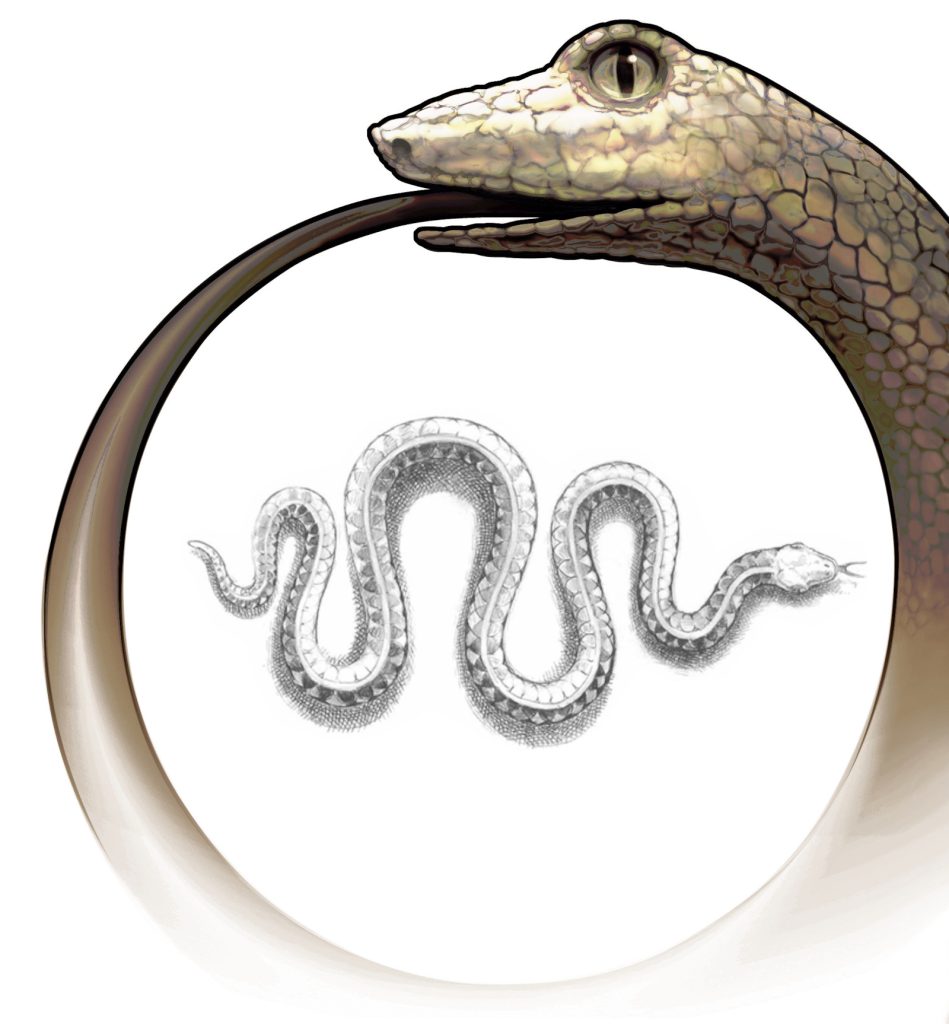
Accordingly, as most minds are academically trained, I will deconstruct the lead illustration to present a macro way of speaking about the enframing nature of academia’s integration of their appliance into the human experience.
Additionally, I will show how such thinking is expressed in the non-Cartesian Second-Language, the Social-Language —Art, which engages a human mind in its inherent metaphorical terms; without the temerity to presume that the creative human mind must invert its cognitive pathways in order to speak academically, which is problematic. The two minds are divergent, yet they naturally bridge. However, the bridging process is to no avail, as academia refuses to collaborate.
Nevertheless, the visual expression is the most simplistic form of an associative array of two elements, which metaphorically communicates a self destructive process in language via the consequential meaning inferred by the association. In other words, AI intends to consume our language, that is to say, steal our legacy.
However, academia claims creative expressions are to be understood as the conscious use of imagination in the production of objects intended to be contemplated as beautiful. As a conceptual artist, I beg to differ, as that lead illustration is far from being beautiful. It is the tip of the spear pointed directly at the trained mind’s lack of humanity, like the Francisco Goya’s painting of the Third of May 1808.
Apparently, academia has determined that Art’s function would be best for all concerned if it is restricted to aesthetic matters befitting its station. However, if we circle-back to deconstructing the lead illustration, as an example of how the Second-Language resonates with the human mind, we understand academia’s furtive glance toward Art, because Art takes precedence to a mind-system’s hypotheticals.
The natural human mind recognizes that a visual expression of any being metaphorically communicates that being’s knowledge. Horse, for example, is knowledge of movement, because that being’s entire evolutionary trajectory is all about movement to its advantage in being. In the cave at Chauvet a horse was positioned prominently dead center of the library (Dalpe, pg. 104, 2018). The movement (horse) that was addressed was explained with the Stag of Ages in the library’s summation, which was to metaphorically state the movement of the ages —History.
That is to say, to the natural mind there is no distinction between the words being and knowledge. Beings are knowledge (Epp, 2002), which means each being expresses a unique type of knowledge.
Hence, in the metaphorical domain if I wish to speak about the understanding of the movement of anything, horse is used in that expression. In context to the lead illustration in this treatise, as a snake’s unique serpentine manner in the way it moves metaphorically speaks of concomitant knowledge, hence, language. Because the snake infers the generational aspect of knowledge formation.
Accordingly, the aforementioned illustration’s juxtaposition of the two linguistic beings as natural and unnatural tells you what I am expressing conceptually about language.
However, as today’s virtual communities are filled with conversations as if academia’s hypothetical narratives are real, I have to ask the question, are humans actually content to live their lives with meaningless words being force fed to them in a virtual Animal Farm, (Orwell, 1945), or is there something else afoot; something more academic?
Out of the Frying-Pan, and into the Fire:
It is well established that knowledge of the Arts will not give us an advantage in practical matters, as the creative mind can not be set to a task, because it is not a procedural mind. Nevertheless, our imagination is the inspiration of all human knowledge, which requires collaboration with the procedural mind to manifest anything practical. However, in that regard academia overestimates their significance, and oversteps their authority.
The symbiotic relationship between conscious and subconscious mental processes, where each mind works in tandem; practical and imaginative respectively, illustrates what a holistic relationship between the mind of academia and the arts could be. Initially, the two minds flourished. However, that success was not enduring.
Apparently, a hive mind was found to be more expedient in accomplishing large scale social projects, with its galvanizing adage, “e pluribus unum.” Yet, a hive mind is not collaboration, it is not creative, and it does not require a human’s inherent curiosity in knowledge formation. It does however require blind faith in the authoritative knowledge of project organizers.
However, a social system in which a human’s formidable creative nature was in contradiction to its organizing principle is problematic; namely, a culture that delegates knowledge formation to a select few would eventually become ripe low hanging fruit.
Project organizers that held the knowledge necessary to accomplish large scale social projects would eventually recognized the brutish power of a hive mind, which was never before conceived of in all of human history. Ergo, the organizing adage “e pluribus unum” did not take long to transfigured into, “si vis pacem, para bellum.”
And there is the rub, which begs the question: is that contradiction in human nature inherent, or is it a consequence of its expedient training that attenuated its creative capacity? With consideration to mass violence against humans that occurred for the first time in all of human history in that context, belief in knowledge is the more cogent explanation for our cultural degeneration. Ergo, the cliché, “Out of the frying pan and into the fire,” aptly depicts that organizing adage. Consequentially, from that pivotal moment to the present day, let’s just say, there were always communication problems between the two camps.
For example, NASA initiated the Johnson Space Center Art Program to collaborate with the Arts. However, the dialogue was abruptly ended when artists began asking questions about the application of color in space imagery (NASA, 1970). Apparently, the issue of color, which is squarely situated in the creative domain, was a bridge too far for what academia considered collaboration.
Like NASA, the origins of the academic mind during the time of Plato was no different. Here is what Plato, AKA way out there Pluto, wrote on the relationship between Art and the government system in his work titled, The Republic. His treatise referred to Art with female pronouns, which I interpreted that Pluto was inferring that Art is subservient; it is not a partner:
… show not only that she is pleasant but also useful to States … so long as she is unable to make good her defense, this argument of ours shall be a charm to us, which we will repeat to ourselves while we listen to her strains (Plato, 375 BC).
We can not move forward with the human mind divided against itself. Without an epistemological understanding of the distinction between the two entirely different minds, the conversation that has yet to happen will remain in the horse latitudes, until academia acknowledges the Arts; on their terms; their language; and their epistemological history, not academia’s systematically biased account.
However, like the stain glass windows of its predecessor’s cathedrals, the Overton Windows of academic universities are transparent to that system’s orthodoxy exclusively, and thus when viewing that “prehistoric” period through those same window panes, we find they are opaque.
There is only one conclusion that can be drawn, the academic mind system is oligarchical, which obscures Art’s epistemological history. Because that history shows that knowledge is built imaginatively. Ergo, by concealment, which is a lie, academia guarantees the most amazing mind nature has ever entertained is rendered into a hive minded Tuffy-Tool™, which Plato explained in no uncertain terms: Art must be pleasant, but also useful, or else … (Plato, 375 BC).
How should an artist respond to such disrespect and dishonest methods from one’s partner? I will avoid responding in kind to Pluto and his academic progeny’s betrayal. Instead, I will express a collective disappointment of the Arts in the Romantic language of Latin: Ars Gratia Artis! Meaning, it is the procedural mind, that is to say the academic mind, that holds that mantel of utility, and do not confuse one for the other.
That conversation between the two camps will never happen voluntarily. But if it does occur in a candid and respectful manner, each human will be afforded a choice as to which path to chose; to be useful or meaningful in their endeavors. That is to say our technological tail will no longer wag the meaningful mind. Otherwise, we are nothing but a Programmable Life Form (PLF) in a bazaar of salivating consumers.
High Maintenance:
Instead of opening a dialogue with Art, academia is reviving its predecessor’s divinely inspired anti-humanism of the Dark Ages, by its repackaging to trans-humanism, which is to couch that ancient duplicity in a technological revolution. What is also apparent is the integration of proprietary AI code into all human social systems is a blatant usurpation of democracy. However, what is more troubling is academia just crossed the Rubicon, as AI is a seminal historical event; it is a clean break with Art; a repudiation of the creative human mind’s social evolutionary trajectory; which was as inevitable as the Third-Language’s transfiguration from mind to machine.
Arguably, academia’s clean break with Art will expedite an Extinction Level Event (ELE), as the blindness in each evolution in language to its progenitor’s, in context to the enframing nature of mind-tech, we become increasingly alienated from our creative capacity. Considering the trained mind is confused by their dreams, and as the Third-Language facilitated ignorance and war as the price for expediency, I anticipate the Forth-Language will usher in the last Dark-Age of conformity and social repression of human imagination that will be stripped of its mantel of forming new words in our social evolution (Madison, 1981). Hence, ELE.
Recognizing the underlying reason for academia’s transfiguration from mind to machine, we have to go back into deep history to the previously mentioned period that academia defines as “prehistoric.” Initially, and by initially, I am referring to the transition from the Pleistocene to Holocene epoch. It was a glacial time of scarcity and uncertainty, as to if the human race would survive the Pleistocene Quaternary. Those were the conditions in which the Mind-Eternal was born, which shaped its exigent characteristic; as is apparent from fertility figures like the Venus of Willendorf (Circa 30 YBP).
When the Earth began to thaw, the exigent characteristic of the Mind-Eternal facilitated the transition from hunter gather societies to agricultural communities, which has not shed its imperative skin during an interglacial warming, and continues unabated with a motion for a machine interface.
During that initial period of trepidation, the human mind looked inward with a level of clarity in self awareness that recognized that all human beings from all ages dream in the same archetypal manner —the First-Language. And they used that insight to speak conceptually beyond the boundaries of emotional expressions of the immediate context. Moreover, they understood recording social conversations in a timeless repository (cave) was a way of speaking across oceans of time, as the social dialogue would expanded from lived experiences to millenniums, i.e., the Mind-Eternal.
The constituents of both the first and second languages were/are metaphorically real and thus only life’s experiences are needed to understand its semantics and syntax. However, as our recorded knowledge became voluminous and more complex, it became necessary to edit that knowledge by making it symbolic in a mind system, i.e., the Third-Language.
For example, the cave of Altamira fleshed out a great age in the Second-Language (Dalpe, pgs. 137-147, 2018). However, when Lascaux was subsequently written, the ages were expressed with only three syntactical marks (Dalpe, pgs. 130-136, 2018)! Consequently, one can not possibility understand Lascaux’s syntax without understanding Altamira on a root metaphorical level.
And there is the second rub. The symbols of a mind system have no meaning whatsoever with our natural mind and its creative cognitive processes. Yes, Art is also mind tech, as it is the technological externalization of human imagination manifest socially. However, the Second-Language maintains a metaphorical bridge between its mind-tech, the human psyche, and the experiential world, which academia does not.
Ergo, the trained mind is rendered creatively infantile, which is incapable of distinguishing between a mind tool and the actual cognitive process of the creative human mind, or subsequently being able to discern the distinction between a hypothetical idea of a mind-system and reality. Likewise, when an academic claims they are speaking hypothetically, they are making a distinction without a difference. Everything they perceive, think, and speak about is hypothetical. Ergo, trained cognitive blindness, i.e., Academic Sensory Syndrome, or the ASS affliction for brevity.
Similar to the logic of the programming language of C++ that requires a compiler to function, first in an assembly language, then to a machine’s binary logic, academia too requires a compiler to transfigure its hypothetical logic to its creative progenitor’s. Hence, the reason for academia’s perpetual propaganda, because like C++ the trained mind does not understand its progenitor’s base language. How could they? Their mind thinks on a higher level language stuck in Chicken Little mode. You know the type. Their high maintenance; everything is an emergency with them, and when they walk into a room the decorum goes straight into the crapper.
Accordingly, AI can continue with academia’s pseudo creative process of evolved sameness, and augment more complex rules based on the fundamentals they were gifted. It can even hasten the pace and complexity. But that will never change the most fundamental rule of all systems, POSIWID: the (Purpose Of a System Is What It Does), not what it claims. That is to say, a hypothetically symbolic mind system and its machine are not minds; they are mind tools.
Root Access is Denied:
Academia and their cybernetic appliance are expedient as well as tenacious, but they are not creative, they do not understand the compiler, and their no time to think, just react methods is the only way to circumvent its rules. Art, however is creative, but due to its training, no longer understands they are the compiler, and thus subsequently fail to recognize their methods are not restricted to its rules.
If I pose that as a question as to which of those two adversaries would prevail in a conflict, Sun Tzu would have concluded, that the former will be triumphant in ever single engagement, until the latter rediscovers their nature.
To facilitate the conditions for such an eventuality, I recommend we think and communicate in our meaningful metaphorical language, not the hypothetical language-system; which is elementary, because that mind-system attenuates meaningful self understanding.
In that campaign, we need to reset language to its original nesting place. Yes, we will lose expediency when communicating, because the Second-Language is not kludgey like the Third-Language. However, that is all we will lose, and in the process we gain meaning. What I am suggesting is we engage in the Art of metaphorically real social expressions beyond the boundaries of that system’s artificially constructed edifices.
We do not need an ability, or be adept at drawing. Because the latter’s highly polished work is a dishonest distraction, and the former because a squiggle will suffice, as our imagination will fill in the blanks. After all, that is what “words” are in the Third-Language; a series of abstractly drawn archetypes and syntactical expressions, i.e., squiggles.
Simply stated the Third-Language used by a machine or a mind trained to think like an appliance, both do not think, they process information in letter-form phrases called words, which are created by the Arts. Necessarily, the Second-Language of the Arts actually thinks in archetypes (letter-forms) in building new word phrases. That has been the social contract ever since our exodus from the glacial garden; Art builds meaning, academia begrudgingly incorporates it into their practice.
To illustrate my point, I will deconstruct the root of the word archetype, which is ARCHE, which also affords me an opportunity to reveal the character of the academic mind system with another one of its foundational deep Greek thinkers, Thales; whose definition of the word “ARCHE” was as metaphorically misleading as way out there Pluto’s rant on the Arts.
Being that Thales was a military commander seated at the head of the Greek government, a government that Pluto wrote his treatise about, it is not too big a leap to presume both were in the business of human husbandry, i.e., culling creativity.
Accordingly, Thales’ definition of the word ARCHE was the commencement of academia’s Gaslighting of the creative mind with his wild assertion, “Water is the nature of all things!” The question is, when was the last time your natural mind dreamed of “all things?” Humm …
Nevertheless, the natural mind does express its point of view with the boundless manifestations of water in context to everything. Yet, each aspect of water is not the nature of anything, except the mind’s self reflections while engaging in worldness. That is to say, water is the mind’s metaphorical expression for self awareness, like viewing ones reflection in a pool of water.
Ergo, Thales’ projection of the mind’s metaphor to becoming the nature of “all things” was de facto academia’s inaugural personification of all knowledge, via the most eminently prosaic philosophy for a military commander; man is the measure of everything!
Regardless, of academia’s repackaging of a middling commander as a great academic thinker, whose claim to fame was for muddying the water, here is how the meaning of ARCHE is actually built metaphorically:
(A) is the syntactical horns, albeit upside down for some systematic reason. Likely to avoid confusion with the (V). Nevertheless, (A) communicates an imaginative idea as opposed to something you actually perceived. (R) refers to that state of (R)easoning in context to (C), which is the horse’s mane and thus communicates knowledge of movement of that state of mind. (H) is a fence, a boundary, which subsequently conveys the idea of that which is peripheral, not central. (E) is also a syntactical state of mind that actually perceives; it does not apperceive like the (A).
Now, string the pearls, which expresses a state of mind whose attention moves between an imaginative idea and that which is actually perceived along its peripheries. That is an interesting concept about the nature of a unique state of mind that is both Cartesian and non-Cartesian when it is being probative.
As is apparent, the abstracted metaphorical images called letters-forms build the meaning of words. As is also apparent, only from self understanding can we recognize how the human mind’s syntax and semantics builds knowledge. However, that process is not expedient. Three archetypes and two syntactical expressions required significant mental contemplation to build or understand meaning. Hence, academia, being the exigent type, utilizes memorization to convey the meaning of words as a kludge; in the same way multiplication uses memorization to expedite addition. For example, Chaucer’s iambic pentameter helps us memorize our times tables:
6-9s be (1 fro 6) 4 maketh 9 —54.
7-9s be (1 fro 7) 3 maketh 9 —63.
8-9s be (1 fro 8) 2 maketh 9 —72.
9-9s be (1 fro 9) 1 maketh 9 —81.
That learning kludge manifests an array of hilarious cognitive entanglements; namely, the repeated application of the same thinking to a problem, while impatiently anticipating a favorable outcome that fails to materialize, because the solution to the problem is often on the meaningful root level. Ergo, round and round we go chasing our tail from one generation to the next.
Obviously, substituting memorization for meaning transforms knowledge into a religion, and as everyone knows, you do not spit into the wind, or argue with a religious learner afflicted with a sever case of Cartesian ASS. The process of understanding how the natural human mind threads metaphorical ideas to say something complex socially is not that difficult for the extemporaneously trained mind, and well worth the effort, as we hold the capacity to create new words, which academia and their cybernetic machine do not, and can not; that requires understanding how meaning builds knowledge, not memorization.
However, to understand how that creative process forms concepts, we need to recognize human syntax. To recognize syntax, we need to acknowledge how the imaginative mind learns, because how we learn is how we syntactically communicate. Ergo, syntax is a state of mind.
For example, if the (A) syntactical expression is associated with the mind’s water archetype (M) that relationship communicates the concept of imagining what the mind does —philosophy. Another example would be when we are dreaming or imagining we are flying like a bird; we are exploring our ideas from a state of mind that holds the commanding heights. That is to say, we must recognize how we are dreaming, not just what we are dreaming. Because that is the syntactical glue that forms the metaphorical aggregate, i.e., stringing the pearls.
However, there is one caveat, we need to use archetypes to speak socially, because they are concepts we all share by virtue of being human. Sure, some archetypes have adapted to the technological environments we have constructed. Like the horse is often expressed as a car.
Nevertheless, most remain the same, water is the mind metaphor, which is why Thales attacked it, as it is at the kernel of the creative mind, while fish expresses a change in the mind, because they are water beings that dart, as where a frog is a liminal being that lives, lingers, and leaps between two seminal domains; water and terra-firma, and so on and so forth.
Such meaningful expressions may move AI disciples to step down from their trans-human virtual pedestals to feel the sun on their face, the wind in their hair, and the earth beneath their feet while listening to life’s lively counterpoise to AI’s lifeless facsimile. But it will not move a cybernetic machine, or a mind trained to think like a system, one iota.
Reawakening, or Clean-Break:
Glaciation could not quell the enduring spirit of the human will, not in a trial of thousands of years. If the danger comes, it will be of our own contrivances. Ergo, the reason for many sleepless nights in both camps on the subject of AI being integrated into our social systems, but for entirely different incentives.
Academia views their trans-human AI campaign as an existential struggle to maintain control of the human mind; similar to when its predecessor was challenged with information tech almost eight centuries ago (Gutenberg’s printing press), which eventually facilitated a Renaissance following a Medieval period of violent upheaval. Accordingly, the Arts understand AI to be a unilateral contract modification effort in bad faith, and breach of fiduciary trust.
There are several elements that are clear in that regard. The first is language came into being when we were challenged during glaciation. Ergo, we must conclude generally that satisfied humans will not be spontaneously progressive during favorable conditions and thus will maintain the status quo. To use a cliché, “If it ain’t broke, don’t fix it.”
Accordingly, many have come to the inescapable conclusion that Art comes alive during conflict, which I do not disagree with as walking straight into that proverbial brick wall is a guaranteed visit from the sand-man. Problems, especially exigent ones, fires up our imaginative boiler, which has kept us alive for eons.
However, today’s conflict between mind and machine, which is the latest struggle in an age old conflict between the two camps, appears to be a bad rerun of the protestant reformation without any hilarious poets like Geoffrey Chaucer, whom obviously had influential sponsors, considering that he avoided being the guest of honor at the academic institution of the time’s popular book and author barbecue extravaganzas. I think we call it deplatforming today; you know, shut down you bank account.
From Plato’s initial assault on Art to academia’s linguistic larceny, that husbanding process required more than two millenniums of regimenting the social mind; i.e., the Mind-Eternal’s transfiguration from the archetypal language of Art to a symbolic mind-system.
What is also apparent is the transformation of that mind-system from human to machine is that construct’s logical conclusion, which is troubling; that academia had no qualms about the transfiguration of the most amazing mind that nature has ever entertained into a Tuffy Tool™, and now dreams of interfacing it with an appliance.
Moreover, when we consider the vast sums of money being spent annually on propaganda and the digital AI control grid, the question of what the enframing nature of AI on the Mind-Eternal will be begins to clarify.
Accordingly, that conversation that has remained in the horse latitudes for millenniums will never happen. AI makes that abundantly clear. Not being a system analyst, I will refrain from forecasting the consequences from such a rash move. Yet, like most divorces; especially ones with way too much baggage attached, such fatal attractions do not have a happy ending. As such, the best one can hope for is a memorandum of understanding MOU.
However, the odds of a MOU being honored are about 854,000 to 1, which is the number of days in academia’s brief, but violent oligarchical reign over the social mind and culture. The question is, what will the Arts do? Will Art permit 50 thousand years of human history to be digitally erased, as our humanity is not part of AI’s equations? And how will that manifest socially when humans recognize the paradox that the social systems they built are inhuman? And what happens in a decade, century or millennium hence when nature’s evolutionary character presents the inevitable rudimentary paradox in AI’s logic? Will that paradox bring the entire system crashing down like an avalanche? And will there be a single human mind left capable of creative thought to dig us out?
Ergo, as an artist, I hold the warranted position that AI must be placed on a very short probational leash for a minimum of a century, and a circumspect human oversight must be part of that system’s algorithms in perpetuity. Because integrating AI into every social system, without so much as a by-your-leave from the Arts, will transform human culture as profoundly as the birth of the Mind-Eternal facilitated the transition from hunter-gatherer societies to agricultural communities.
However, the alpha and omega of that grand social experiment envisioned at Chauvet is now beginning to materialize as a hilarious comedy that began as cooperation in collective farming to becoming commodities in portfolios of futures contracts managed by an appliance. Ergo, no matter what exigent circumstances academia manufactures, AI can not be permitted to roam free without a chaperon.
Paramount to that oversight is AI must be open-source; as no one can be excluded from that social process, nor can anyone copyright a language any more than one can copyright the being that has built and has spoken that language for 50 millenniums.
And there is the third rub. The academic mind trained with a mind-system obviously views everything in systematic terms and thus insists language performed by a machine is also a thing and therefore it can be copyrighted.
I hope it is clear that is a genetic fallacy on par with Descartes’s Epistemological Doubt, (Searle, 2005), both of which are symptoms of a severe case of ASS. Claiming that a machine appears to be able to language does not make that language a thing, any more than my claim of a car that appears to move like a mustang must be a horse.
The Arts understand that languaging is a meaningful performative social action, a verb. It is what the creative human mind does in knowledge formation as naturally as dreaming. It is a social expression of being. It is only a thing to religious learners trained to think in symbols of a hypothetical mind system.
Ergo, languaging, no mater how it manifests, be it the First-Archetypal-Language of the dreaming mind, the Second-Social-Language of Art, the academic Third-Language mind-system, or the Fourth-Language’s machine automation of the Third-Language; all are different evolutions of the Mind-Eternal that began during the late Mousterian Industry, which no individual may claim entitlement to copyright, ownership, or sovereignty.
Nevertheless, I would like to end the treatise on a positive note by considering that after thousands of years of Art being sidelined and forced to live on the peripheries of academia’s cultural bazaar; a utilitarian culture that erased our history, yet the artistic spirit has not only endured, it has prevailed, there may yet be hope.
Bibliography:
- Dalpe, Edmund W; Dream Duet; https://www.amazon.com/Dream-Duet-Edmund-Dalpe-MFA/dp/1986742164; 2018.
- Dalpe, Edmund; Seaman Bartleby & The Bloody Color Revolution; https://thelionsgait.com/2021/09/03/seaman-bartleby-the-bloody-color-revolution/; 3 September 2021.
-
Epp, Ellie, Aboutness, Simon Fraser University, 2002.
- Fitts, Catherine Austin; The Solari Report; https://solari.com/: 2026.
- Gopnik Allison; The Philosophical Baby; Picador Publishing; 2009.
- Madison, Gary Brent; The Phenomenology of Merleau-Ponty; Ohio University Press; 1981.
- NASA; Johnson Space Center Art Program; 1970.
- Orwell, George; Animal Farm; https://dn710604.ca.archive.org/0/items/AnimalFarmByGeorgeOrwell/Animal%20Farm%20by%20George%20Orwell.pdf: 1945.
- Plato; The Republic; https://www.gutenberg.org/cache/epub/1497/pg1497-images.html; 375 BC.
- Searle, John R.; Mind: A Brief Introduction; Oxford University Press, 2005.
Copyright, 4 July 2026, All Rights Reserved.